Anodized vs. Powder Coated Aluminum Furniture Profiles: Sourcing & Engineering Guide
Quick Executive Takeaway for Product Designers & Buyers
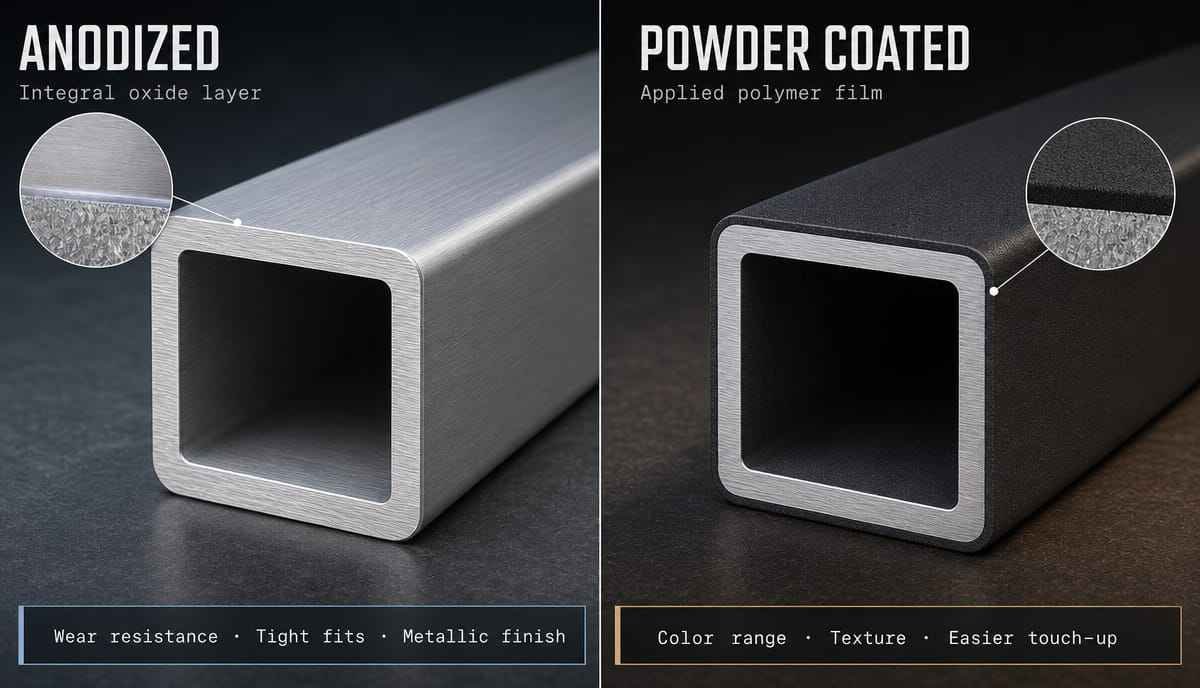
Specify Anodizing (QUALANOD AA10/AA15): Essential for authentic metallic luxury in minimalist interior systems—brushed champagne, satin titanium gray, and deep bronze. The anodic film is an integral electrochemical conversion layer (10–15 μm) that will never peel, flake, or chip, offering superior surface micro-hardness (HV 300+).
Specify Powder Coating (QUALICOAT Class 1/2): The premier choice for zero-gloss architectural textures (ultra-matte sand textures, warm skin-touch finishes, and exact RAL/Pantone color matching). Powder coats provide thicker physical shielding (60–80 μm) that completely masks minor extrusion die lines and provides superior resistance to household acidic cleaning agents.
Tolerance & Mating Dimensions: Anodizing adds negligible thickness (+5 μm per surface), keeping tight CNC snap-in tolerances intact. Powder coating adds 60–80 μm per side (up to 0.16 mm total across slots), which requires CAD groove compensation to avoid binding during hardware assembly.
In contemporary modular furniture and architectural joinery design, the surface finish of an aluminum profile is not merely cosmetic—it dictates touch temperature, chemical resistance to cleaning agents, anti-fingerprint performance, and assembly tolerance budgets.
Selecting between **anodizing** and **powder coating** involves trade-offs between metallurgical authenticity and color flexibility. Choosing incorrectly can result in catastrophic corner paint flaking during CNC miter sawing, or visible batch color discrepancies across an entire kitchen cabinet line. This guide compares both finishing systems across certified mechanical, chemical, and cost benchmarks.
Certified Engineering Performance Benchmark
The performance matrix below compiles verified testing data governed by international QUALANOD (anodizing) and QUALICOAT (powder coating) architectural standards:
| Performance Dimension | Anodizing (QUALANOD AA10/15) | Powder Coating (QUALICOAT Class 1/2) | Furniture Sourcing & Assembly Impact |
|---|---|---|---|
| Layer Structure | Al₂O₃ Ceramic Conversion Layer | Thermoset Polyester / Polyurethane Film | Anodizing is part of the metal; powder coat is a bonded topical resin. |
| Coating Thickness | 10 – 15 μm (AA10 / AA15) | 60 – 80 μm (Architectural standard) | Powder coat thickness alters internal channel dimensions by up to 0.16 mm. |
| Surface Micro-Hardness | HV 300 – 450 (Diamond-like hard) | 2H – 4H Pencil Hardness | Anodized profiles offer superior resistance to scratches from metal keys and rings. |
| Chemical & Cleaner Resistance | Moderate (Sensitive to pH < 4 or > 9) | Excellent (Wide pH 2 – 12 tolerance) | Powder coat resists aggressive kitchen degreasers, bleach, and citrus cleaners better. |
| Color & Texture Versatility | Metallic spectrum (Silver, Gold, Bronze, Black) | Unlimited (Full RAL/Pantone, Sand, Soft-Touch) | Powder coating enables seamless color matching to cabinetry laminates and wall paint. |
| Extrusion Blemish Concealment | Poor (Highlights micro-die lines) | Excellent (Completely masks surface grain) | Anodizing requires superior billet quality and frequent die polishing. |
Deep Dive: Finishing Mechanisms & Aesthetic Differences
A. Anodizing: The Natural Metallic Choice for Luxury Minimalist Lines
Anodizing is an electrolytic passivation process that converts the outer aluminum layer into a porous sapphire-hard aluminum oxide matrix ($Al_2O_3$). For high-end furniture:
Authentic Metallic Tactility: Retains the cool, crisp touch of raw metal with zero plastic sensory feel.
Mechanical Integrity during Cutting: Because the layer is structurally part of the substrate, 45° CNC miter saw cuts produce zero flaking, peeling, or fringe tearing along the sharp cutting edge.
Mechanical Sheen Variants: Available in chemical matte etch (E6), mechanical linear brushed (E3), and bead-blasted satin finishes that cannot be replicated with liquid or powder paints.
B. Powder Coating: Modern Matte Textures & Complete Environmental Shielding
Electrostatic spray deposition of dry resin particles followed by 200°C thermal polymerization creates a dense, continuous polymer shield:
Deep Non-Reflective Matteness: Architectural fine-sand powders achieve ultra-low gloss levels (< 5 GU at 60°), eliminating harsh glare in modern integrated LED ambient lighting schemes.
Flawless Blemish Concealment: The 60–80 μm build easily bridges minor extrusion die lines and extrusion chatter marks, enabling higher yield rates on wide, flat profile surfaces.
Broad Chemical Immunity: Unlike anodized coatings which dissolve under strong alkaline kitchen detergents, polyester-polyurethane hybrid coatings resist wine, vinegar, and ammonia cleaners without staining.
Engineering Boundary Conditions: When One Choice Fails
Experienced furniture engineers enforce strict boundary rules based on environment and functional demands:
Avoid Anodizing in High-Alkaline Environments: Open-flame cooking grease and aggressive industrial dishwashing detergents with pH > 9.5 will chemically attack the anodic pore seal, causing white chalky bloom that cannot be buffed out.
Avoid Powder Coating for Tight Slip-Fit Hardware: If an extrusion cross-section includes snap-in nylon corner blocks or rubber glass gaskets engineered with less than 0.20 mm tolerance clearance, powder coating will choke the channel and require manual scraping during assembly.
Batch-to-Batch Color Shifts (Anodizing Risk): Anodizing color relies on microscopic light absorption in dye baths. For multi-thousand square meter projects requiring multi-month delivery schedules, color consistency ($Delta E < 0.8$) requires strict batch mixing controls. Powder coating offers superior batch-to-batch color repeatability.
Sourcing & Procurement Checklist for OEM Furniture Buyers
Surface Finishing Purchase Specification Checklist:
Define the Film Thickness Grade: For anodized parts, mandate QUALANOD Class AA10 (10–14 μm) for dry interiors, or Class AA15 (15–19 μm) for bathrooms and coastal environments. For powder coating, mandate 60–80 μm.
Check Powder Brand Grade: Demand Tier-1 architectural powders (AkzoNobel Interpon, Tiger Drylac, or Axalta) to guarantee 10-year gloss retention and zero UV yellowing.
Corner CNC Sawing Test: Require the factory to provide a video of a 45° high-speed miter-saw cut test. Any coating delamination along the acute edge fails inspection.
Specify Sealing Method for Anodizing: Mandate cold nickel fluoride sealing followed by hot deionized water rinses to prevent fingerprint smudge retention.
Frequently Asked Surface Finishing Questions
Q1: Which finish is more resistant to scratches from daily use?
Anodizing provides significantly higher micro-hardness (HV 300+ vs. 2H–4H pencil hardness for powder coatings). However, if an anodized profile is subjected to a deep gouge past its 15 μm layer, raw silver metal is exposed. Powder coat is softer but can absorb impacts more elastically without exposing bare metal.
Q2: Is powder coating cheaper than anodizing for custom profiles?
Standard white and black powder coatings are typically 5% to 10% more economical than anodizing because powder lines run at higher throughput with lower wastewater treatment overhead. However, high-grade super-durable architectural powders (QUALICOAT Class 2) with custom metallic flecks cost comparable to or slightly higher than standard anodizing.
Q3: Can powder coated profiles achieve the same matte black look as anodized black?
Both achieve stunning black finishes, but the visual texture differs. Anodized matte black reveals subtle metallic grain with anisotropic light reflection. Powder coated fine-sand black (RAL 9005) delivers a solid, velvety, non-directional shadow effect with near-zero reflectivity.
Perfect Your Aluminum Furniture Profile Surface Finishing
NiceAluminum operates state-of-the-art vertical powder coating and automated horizontal anodizing lines compliant with QUALANOD and QUALICOAT Class 2 standards. Request custom swatches today.
Request Free Anodized & Powder Coated Sample Kit
 Email
Email Whatsapp